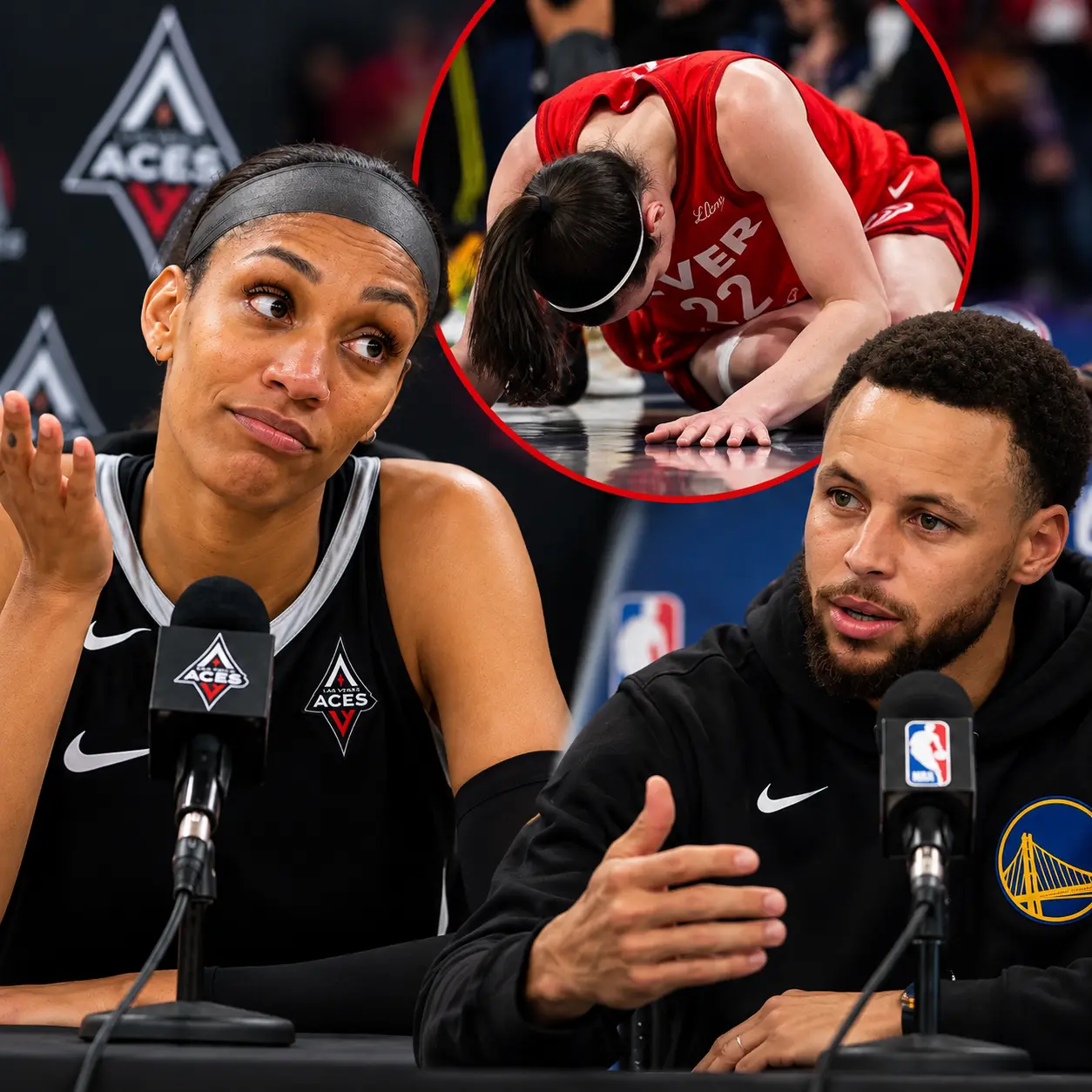
A’ja Wilson–Caitlin Clark Controversy Erupts Online as Stephen Curry Is Pulled Into Viral Basketball Debate
A heated basketball controversy involving Caitlin Clark and A’ja Wilson has exploded across social media, with Stephen Curry now being pulled into a viral narrative that has generated intense debate among fans.
At the center of the story is a physical play involving Clark, followed by an inflammatory quote circulating online and attributed to Wilson. According to viral posts, Wilson allegedly mocked Clark’s reaction to the contact and called her a “terrible actress,” before Curry supposedly stepped into the controversy with a firm response.
The most provocative version of the alleged Wilson quote reads:
“I only pulled her hair a little, but she acted like she’d been hit hard. She really made it look dramatic. Honestly, she deserved it.”
It is exactly the kind of statement guaranteed to set basketball social media on fire.
But there is an important problem with the story: the quote attributed to Wilson, as well as the claim that Curry responded to it live on television, should not be treated as verified without an identifiable interview, broadcast clip, transcript, or credible report confirming those words.
That distinction matters because an already controversial basketball play can easily turn into something much larger once unverified quotations are added.
And when the names involved are Wilson, Clark and Curry, almost anything can go viral.
Caitlin Clark Remains at the Center of Basketball’s Biggest Debates
Few players generate discussion as quickly as Clark.
Since becoming one of the biggest names in women’s basketball, the Indiana Fever guard has attracted extraordinary attention not only for her shooting and passing, but also for virtually every physical interaction she experiences on the court.
A hard screen becomes a debate.
A missed foul becomes a debate.
A confrontation becomes a debate.
A replay lasting only a few seconds can generate thousands of comments within minutes.
Some fans believe Clark receives unusually aggressive defensive treatment because opponents understand how important she is to Indiana’s offense.
Others argue that physical defense is simply part of professional basketball and that Clark should not be treated differently from other elite players.
Those disagreements have followed her throughout her professional career.
The result is an environment in which virtually any controversial contact involving Clark can become national sports content.
That is exactly why an alleged comment accusing her of “acting” after contact would attract so much attention.
Wilson’s Name Makes the Story Even Bigger
A’ja Wilson is not simply another opponent.
She is one of the defining players of her WNBA generation.
Her accomplishments, dominance around the basket, defensive presence and status within the Las Vegas Aces have established her as one of the most recognizable figures in women’s basketball.
Putting Wilson and Clark on opposite sides of a controversy therefore creates an irresistible sports-media storyline.
One represents established WNBA excellence.
The other represents a newer wave of enormous mainstream attention.
Fans naturally compare them even though they play different positions and have different responsibilities.
That contrast can be entertaining.
But it can also encourage exaggerated narratives.
A disagreement over a foul can suddenly become a personal feud.
A facial expression can be interpreted as disrespect.
A short clip can be presented as proof of hostility.
And an unverified quotation can transform competitive tension into an apparent personal attack.
That is why the alleged “terrible actress” remark requires caution.
If Wilson made such a statement, the original source should be identifiable.
Where was she speaking?
Who interviewed her?
When did she say it?
Is there video?
Is there a complete transcript?
Without those details, quotation marks can create a level of certainty the available evidence does not support.
The Physicality Question Is Bigger Than One Play
Even without the alleged quotation, the underlying discussion is legitimate.
How much contact should WNBA officials allow?
When does aggressive defense become excessive?
Should referees intervene earlier when games become increasingly physical?
Those questions do not apply only to Clark.
Professional basketball requires contact.
Players fight for rebounding position. Defenders navigate screens. Guards use their bodies to protect the ball. Post players establish position with considerable force.
Not every collision is dirty.
Not every foul is intentional.
And not every missed whistle represents favoritism.
At the same time, player safety matters.
Contact involving the head, neck or hair can appear especially alarming on replay, and officials are responsible for determining whether an action is a common foul, something more serious, or legal basketball contact.
The difficulty is that fans have something officials do not: unlimited replay.
A referee sees the play once at full speed.
Viewers can watch it 20 times from multiple angles.
That difference helps explain why officiating controversies can grow long after the game ends.
Did Clark “Sell” the Contact?
This is where the viral story becomes particularly inflammatory.
Accusing a player of exaggerating contact is common in basketball.
Players attempt to draw fouls.
They emphasize illegal contact.
Sometimes they fall dramatically.
Sometimes they legitimately lose their balance.
Sometimes a collision looks mild from one camera angle and severe from another.
Determining what a player felt in the moment is much more difficult than social-media posts often suggest.
Clark plays at high speed and frequently handles the ball under pressure. When bodies collide during fast movement, even relatively brief contact can dramatically change balance.
That does not mean every reaction is proportionate.
It also does not mean every reaction is theatrical.
The replay has to be evaluated individually.
The problem with the alleged Wilson quote is that it skips directly past that analysis.
It assigns motive.
According to the viral wording, Clark was not merely reacting to contact; she was supposedly “acting.”
That is a much stronger accusation.
And unless Wilson actually made it, it should not be placed in her mouth.
Then Stephen Curry Entered the Viral Story
As if Clark versus Wilson were not enough to dominate social media, another enormous name was added to the narrative: Stephen Curry.
Viral versions of the story claim Curry responded after Wilson’s supposed criticism and delivered a “firm message” during a television appearance.
The framing is designed perfectly for engagement.
Wilson says something controversial.
Fans become angry.
Then an NBA superstar arrives.
He responds calmly.
The room supposedly changes.
Social media explodes.
It has all the structure of a dramatic sports movie.
What it needs, however, is evidence.
A genuine Curry television response should be relatively easy to establish.
Which network aired it?
What program?
Who interviewed him?
What exactly did he say?
Is there a video?
Until those questions are answered, Curry’s supposed intervention should not be described as established fact.
Why Curry Is a Perfect Name for Viral Clark Stories
The reason the story sounds believable is obvious.
Curry and Clark are frequently connected in basketball conversations because of their extraordinary shooting range.
Clark has never hidden the influence that long-distance shooting has had on modern basketball.
Curry fundamentally changed perceptions of what constituted a reasonable shot in the NBA. Pull-up three-pointers from well beyond the traditional line became part of modern offensive strategy partly because of what Curry demonstrated was possible.
Clark became famous for similarly ambitious shooting distances in women’s basketball.
They are not identical players.
Their careers exist in different leagues and circumstances.
But the visual comparison is obvious enough that fans frequently connect them.
Therefore, when Curry’s name appears in a Clark story, audiences are primed to believe he might have something to say.
That makes him especially useful in viral content.
It also makes verification especially important.
Social Media Loves a Hero-and-Villain Structure
Sports are naturally dramatic, but social media often simplifies that drama into easily understood roles.
One person becomes the victim.
Another becomes the villain.
A third becomes the defender.
In this viral narrative, the roles are immediately recognizable.
Clark is portrayed as the player subjected to questionable contact.
Wilson becomes the star allegedly mocking her afterward.
Curry becomes the respected outsider who supposedly steps in to defend Clark.
That structure encourages emotional engagement.
People do not merely discuss basketball.
They choose sides.
And once they choose sides, every new piece of information is interpreted through that allegiance.
Wilson supporters may view the story as another attempt to demonize an established WNBA star.
Clark supporters may see it as another example of their favorite player being treated unfairly.
Curry fans may celebrate a statement he may never have made.
The argument becomes enormous even before anyone establishes whether the central quotes are authentic.
Clark’s Popularity Has Changed the Scale of WNBA Conversations
The attention surrounding Clark is difficult to overstate.
Women’s basketball was already growing rapidly before her professional arrival, with established stars, successful franchises and expanding interest.
But Clark brought an additional audience from her record-breaking college career.
Some of those fans were longtime basketball viewers.
Others had begun watching specifically because of her.
When that audience followed her into the WNBA, ordinary regular-season moments suddenly gained extraordinary reach.
Opponents became more recognizable.
Press conferences received more views.
Officials faced increased scrutiny.
Coaches’ comments traveled further.
That attention benefits the league commercially and culturally.
But it also produces tension.
Established stars who spent years building the WNBA can find themselves repeatedly asked about one player.
Every interaction can become part of a Clark-centered storyline.
That dynamic can create narratives that do not accurately represent relationships among the players themselves.
Wilson’s Legacy Should Not Be Reduced to Clark
Wilson’s career deserves to be discussed independently.
Her impact on the WNBA was established before Clark arrived.
Her individual achievements and team success are not dependent on a rivalry with Indiana’s star guard.
That makes fabricated or exaggerated conflict particularly unhelpful.
There is already a compelling basketball matchup.
Wilson’s interior dominance presents completely different tactical problems from Clark’s perimeter creation.
Aces-Fever games can be analyzed through defensive schemes, transition offense, rebounding, spacing and shot creation.
There is no shortage of genuine basketball material.
Turning every meeting into a personal feud risks overshadowing the sport itself.
Clark Does Not Need to Be Portrayed as Helpless
The opposite distortion can happen with Clark.
Because fans frequently focus on hard fouls against her, she can sometimes be portrayed as if she is simply absorbing punishment while everyone else controls the game.
That image does not reflect the competitiveness that helped make her famous.
Clark is an aggressive player.
She talks to officials.
She competes physically.
She makes mistakes.
She becomes frustrated.
She responds to opponents.
She is not merely a passive figure in these games.
Treating her like one can be just as misleading as dismissing every hard foul against her as meaningless.
Elite athletes operate in a difficult middle ground.
They can be exceptionally tough and still be legitimately fouled.
They can complain about one call and be correct about another.
They can exaggerate contact occasionally without every future reaction becoming fake.
Nuance matters.
The Officials Are Under the Microscope
No group experiences the consequences of Clark’s enormous visibility more immediately than WNBA officials.
Every disputed decision is amplified.
If they call a foul, one side argues Clark receives superstar treatment.
If they do not call it, another side argues opponents are allowed to target her.
There may be no decision capable of satisfying everyone.
The answer is consistency.
Similar contact should produce similar decisions regardless of the players involved.
That standard sounds simple.
Executing it in a fast professional basketball game is considerably more difficult.
Still, consistent officiating is essential to maintaining confidence among players, coaches and fans.
When controversial sequences occur, clear explanations and transparent application of the rules can prevent speculation from overwhelming the actual basketball.
Rivalries Are Good — Fabricated Quotes Are Not
The WNBA does not need to avoid rivalry.
Quite the opposite.
Rivalries are one of the engines of professional sports.
Fans want rematches.
They want competitive history.
They want players who challenge one another.
They want playoff series that feel personal because both teams desperately want to win.
Wilson and Clark can become part of compelling competitive storylines without fake hostility.
If they genuinely disagree publicly, report it.
If one criticizes the other, quote the actual statement.
If they exchange words on the court, show the footage.
Authenticity produces stronger sports history than manufactured conflict ever can.
What Would Curry Actually Add to the Discussion?
If Curry eventually comments directly on a controversial Clark play, his perspective would naturally attract attention.
As an elite guard who has spent years dealing with aggressive defenses, off-ball grabbing and constant physical attention, he could provide useful insight into how star perimeter players experience contact.
But that is exactly why his genuine words would matter.
Inventing a response undermines the value of anything he actually says later.
The same applies to Wilson.
And Clark.
Fans deserve to know when a quote is real.
One Clip Can Now Travel Around the World in Minutes
The modern sports-media ecosystem is extraordinarily fast.
A controversial play happens.
Someone records it.
A clip reaches social media.
A caption is added.
Another account reposts it with stronger language.
A quotation appears.
Then another famous athlete is attached to the story.
Within hours, thousands of people may believe they watched an entire controversy unfold even though several important details were never verified.
That process explains why dramatic sports stories require careful sourcing.
The more perfectly a quote fits the narrative, the more valuable it is to locate the original video.
The Real Story Is Already Compelling
Remove the unverified quotes and there is still plenty to discuss.
Clark continues to receive enormous defensive attention.
Wilson remains one of basketball’s most accomplished active stars.
Physicality remains a major part of WNBA competition.
Officiating remains intensely scrutinized.
Fans continue debating whether Clark is treated fairly.
The league continues navigating the opportunities and complications created by unprecedented attention.
And NBA stars such as Curry inevitably become part of broader conversations about how modern basketball is evolving.
None of those subjects requires invented drama.
Where the Controversy Goes From Here
If authenticated footage emerges showing Wilson making the alleged remark, the story changes immediately.
Her exact wording and complete context could then be evaluated.
Likewise, if Curry genuinely addressed the issue on television, his actual comments should replace vague claims about a supposedly devastating response.
Until then, the responsible conclusion is straightforward.
There is a viral story.
There is a controversial basketball discussion.
But there is not enough verified evidence presented here to treat the dramatic quotations as established fact.
That may not be as explosive as the headline.
It is, however, the difference between reporting what happened and repeating what social media claims happened.
And perhaps that distinction is especially important in the Caitlin Clark era.
Every play involving her already carries enormous attention.
Every matchup with a superstar such as Wilson already attracts debate.
Every connection to an NBA icon such as Curry already guarantees clicks.
Basketball does not need additional fiction.
Let the rivalry develop on the court.
Let Clark’s performances speak for themselves.
Let Wilson’s accomplishments and words stand on their own.
Let Curry decide when he wants to enter the conversation.
Because if these three names ever genuinely collide in one major basketball controversy, nobody will need to manufacture the drama.
The real thing will be more than enough.