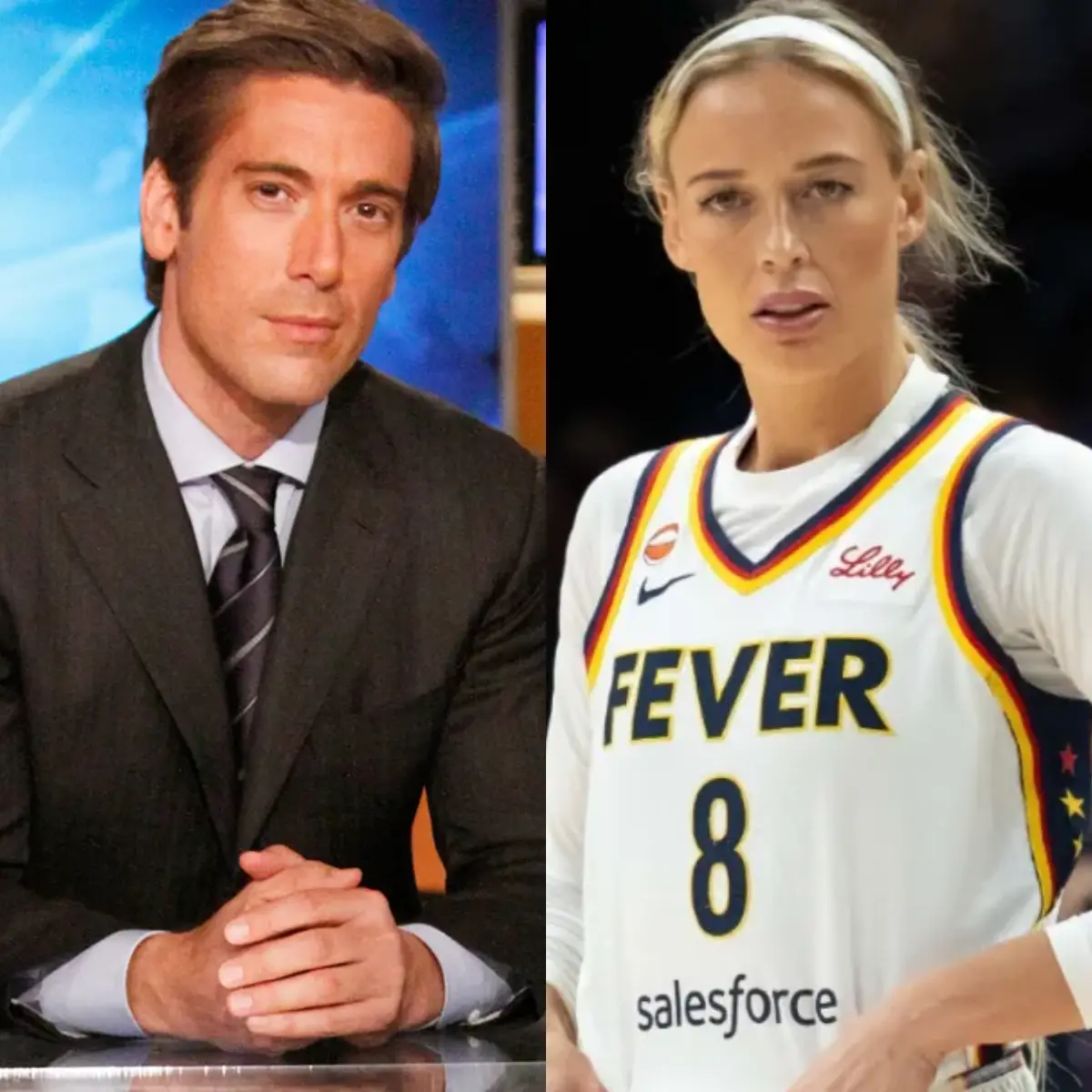
“YOU SMEARED MY NAME ON NATIONAL TV — NOW YOU’LL ANSWER IN COURT!” Sophie Cunningham Faces a Reputation Battle in an Explosive Media Drama
The studio lights were supposed to illuminate another ordinary sports debate. Instead, in this imagined story, a nationally televised segment becomes the beginning of a confrontation that threatens to spill from the screen into a courtroom. At its center stands Sophie Cunningham, determined to challenge a narrative she believes has transformed her competitive personality into something unrecognizable.
The controversy begins when fictional television presenter Adrian Vale delivers a sharply worded commentary about Cunningham. His broadcast moves beyond discussing basketball performances and starts drawing sweeping conclusions about her character. By the following morning, clips from the segment are circulating alongside increasingly sensational captions, creating a public argument that neither side can easily control.

For Cunningham, the most painful detail is the distance between the original footage and the story now spreading around it. A brief courtside exchange has become the foundation for accusations about motives, temperament, and professional credibility. The more the clip travels, the less anyone appears interested in what happened before the camera started recording.
Her first response, within this fictional account, is silence. She watches the segment again, sets her phone aside, and tries to concentrate on the next practice. Yet the silence becomes another part of the controversy, with some viewers treating her refusal to immediately respond as evidence that the presenter must have uncovered something significant.
That interpretation finally pushes the dispute into a different phase. Cunningham meets with an imagined advisory team and asks a question that changes the mood in the room: what happens when commentary stops examining an athlete’s performance and starts rewriting her identity? Nobody offers an easy answer, but everyone understands that the consequences now extend beyond one uncomfortable evening.
Then comes the statement that ignites the story.
“You smeared my name on national TV — now you’ll answer in court,” the fictional version of Cunningham declares. The words are direct, angry, and impossible to mistake for a routine public-relations response. Within minutes, the argument shifts from whether the broadcast was unfair to whether the confrontation could become an extraordinary legal spectacle.
In this invented scenario, a proposed demand of $25 million becomes the detail dominating every discussion. The figure is a fictional storytelling element, not an actual claim, filing, or assessment of damages. Inside the narrative, however, it gives the controversy a scale that turns an already heated disagreement into a national obsession.
Supporters see the demand as a declaration that public visibility does not erase a person’s right to defend her reputation. They argue that athletes should not have to accept every damaging characterization simply because attention comes with their profession. To them, Cunningham’s response represents a boundary that should have been drawn long before the broadcast aired.
Critics read the same moment differently. They question whether an enormous monetary demand risks making the dispute appear more theatrical than principled. Others worry that escalating the confrontation could keep the original commentary alive for weeks, exposing Cunningham to the very scrutiny she wants to escape.

The fictional network initially responds with a restrained statement defending the importance of robust sports discussion. Its language emphasizes commentary, interpretation, and the role of disagreement in public debate. What it does not provide is a clear explanation of why the segment presented uncertain conclusions with such confidence.
That omission becomes the next flashpoint. Viewers begin comparing the presenter’s strongest statements with the limited material shown during the broadcast. In the story, the gap between what the audience can observe and what Vale insists it means becomes harder to ignore.
Behind the scenes, Cunningham’s imagined advisers resist the temptation to answer every viral accusation. They assemble a timeline, preserve the broadcast, and identify the specific statements she disputes. Their focus is on making her objection understandable, even as the surrounding conversation becomes increasingly emotional.
For Cunningham, the emotional cost remains harder to organize. She can prepare for an opponent, study a defensive assignment, and recover from a difficult game. She cannot control how thousands of strangers interpret a few seconds of footage after someone else has supplied the explanation.
One evening, the fictional narrative finds her sitting alone after practice, scrolling through messages that alternate between encouragement and hostility. Some strangers insist they know exactly who she is; others demand that she prove them wrong. The experience leaves her confronting the strange reality of being discussed everywhere while feeling heard almost nowhere.
The presenter, meanwhile, faces his own moment of decision. Vale could clarify what he meant, acknowledge the limits of the footage, or double down on the segment that brought him extraordinary attention. In this story, his hesitation becomes consequential because every hour without clarification allows the most extreme interpretation to spread further.
The controversy reaches its emotional peak when Cunningham appears before a small group of reporters. There is no dramatic entrance and no triumphant announcement of a courtroom victory. Instead, she explains that the dispute has forced her to think about how quickly an athlete can lose ownership of her own story.

“You can criticize my game,” she says in invented dialogue. “You can disagree with me, and you can say I had a bad night. But if you tell people who I am, you should be prepared to explain what you based that on.”
Her statement does not end the argument. It does, however, expose the central tension beneath the spectacular headline and enormous fictional demand. The confrontation is about the difference between reacting to someone’s visible actions and claiming certainty about the person behind them.
By the closing scene, no lawsuit has been resolved, no damages awarded, and no definitive winner declared. Cunningham returns to the basketball court while the network considers whether to broadcast a clarification. The uncertainty leaves both sides facing a choice about what matters more: protecting their pride or correcting the record.
The final image is quieter than the opening threat. Cunningham steps onto the floor, takes a pass, and begins another repetition while conversations about her continue elsewhere. In this imagined drama, defending a reputation starts with a public challenge, but reclaiming a life requires something more enduring than the loudest headline.
Illustrative photos of Sophie Cunningham; these do not depict the fictional controversy.