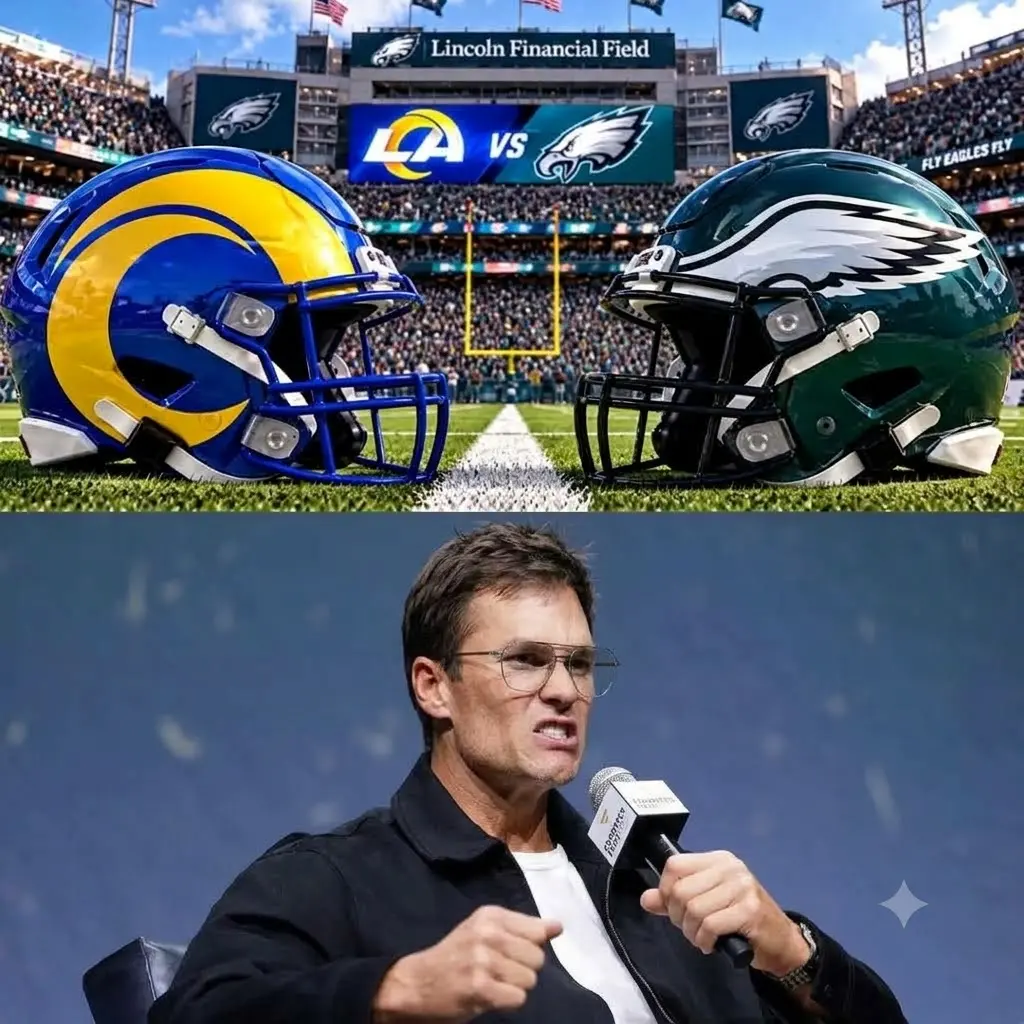
🚨🏈 TOM BRADY MAKES HIS CALL: BRADY OFFERS A BOLD BREAKDOWN OF RAMS VS. EAGLES — AND HIS SCORE PREDICTION HAS NFL FANS TALKING
When Tom Brady talks about quarterback play, late-game pressure, and what separates winning football from losing football, people tend to listen. So when the seven-time Super Bowl champion was placed at the center of the conversation surrounding the Los Angeles Rams and Philadelphia Eagles, the matchup immediately felt bigger. In this commentary-style scenario, Brady’s breakdown begins with one central idea: this is the type of game that can be decided by only three or four possessions. One protection breakdown, one turnover, one failed third down, or one explosive play could completely change the afternoon. On one side, Los Angeles presents the kind of offensive challenge capable of forcing Philadelphia to defend every section of the field. The Rams’ offensive structure has long emphasized timing, spacing, motion, and creating favorable matchups before the quarterback even receives the snap. Against an aggressive Eagles defense, patience becomes critical. Philadelphia wants quarterbacks uncomfortable. The Eagles want to collapse the pocket, disrupt timing, and turn predictable passing situations into opportunities for their defensive front. The Rams therefore cannot afford to spend the entire game facing third-and-long. Staying ahead of the chains through efficient early-down football would be one of the first keys Brady would identify when studying this matchup.

Philadelphia, meanwhile, brings a different kind of pressure offensively. The Eagles have built much of their identity around physical football, quarterback mobility, explosive opportunities, and an offensive line capable of influencing the geometry of a game. When Philadelphia controls the line of scrimmage, everything becomes easier. The running game forces defenders closer to the box. Play-action becomes more dangerous. Receivers find additional space. And the quarterback gains opportunities to extend plays when the initial structure breaks down. For the Rams, the challenge is maintaining discipline. Overreact to the run, and Philadelphia can attack behind the defense. Play too conservatively, and the Eagles can grind out long possessions that exhaust a defense. Brady’s hypothetical film-room perspective would naturally focus heavily on quarterback decision-making. Few players in NFL history understood situational football better. The spectacular throws matter, but many close games are determined by the decisions that never become highlight clips: throwing the ball away instead of forcing a pass, changing protection before a blitz, recognizing when a defense is disguising coverage, taking the checkdown, or understanding when field position matters more than attempting something heroic. That principle could become particularly important in a Rams-Eagles matchup because both defenses have the potential to punish impatience. The quarterback who remains comfortable taking five yards instead of hunting twenty on every snap may ultimately be the one controlling the fourth quarter. Another major factor is red-zone efficiency. Moving the ball between the 20-yard lines can create impressive statistics without producing victories. Against quality opponents, drives must end with touchdowns. Settling repeatedly for field goals gives the opposing offense too many opportunities to change the game with one explosive possession. Philadelphia’s physicality can become particularly valuable near the goal line, where space disappears and defenses have fewer areas to protect. Los Angeles, meanwhile, needs creativity and execution to prevent the Eagles from dictating those compressed-field situations. Brady would also likely emphasize protection adjustments. Every elite quarterback eventually learns that blocking is not simply an offensive-line responsibility. The quarterback participates in protection through identification. Where is the extra rusher coming from? Is the defense actually blitzing or merely threatening pressure before dropping into coverage? Does the running back need to remain in protection? Should the ball come out immediately? Those questions can determine whether an offense creates a 25-yard completion or absorbs a drive-killing sack. Then there is the psychological battle. Philadelphia is one of the NFL’s most emotionally intense environments, and Eagles games can quickly develop momentum that feels almost physical. A defensive stop energizes the stadium. A sack amplifies the next snap. A turnover can transform the entire atmosphere. Visiting teams cannot allow the emotion of the moment to change their decision-making. Brady experienced enough hostile environments during his career to understand that the solution is rarely matching chaos with chaos. The solution is communication, tempo control, and execution. Silence a stadium with a long touchdown drive and suddenly the emotional advantage begins disappearing. The Rams’ ability to remain composed therefore becomes as important as any individual matchup. Philadelphia faces its own pressure. Expectations can become dangerous when a team believes it should control a game simply because it is playing at home. Aggressiveness must remain calculated. The Eagles cannot give Los Angeles short fields through unnecessary mistakes. Against a disciplined opponent, one careless turnover can erase twenty minutes of otherwise excellent football. Special teams also deserves attention. Close NFL games frequently swing on hidden yardage: a poor punt, a long return, a missed field goal, or a penalty that changes field position. Those moments rarely receive the same pregame attention as quarterbacks and star receivers, but Brady’s career repeatedly demonstrated how postseason-style football can be decided by tiny margins. The same principle applies here. If the game remains within one possession late, every yard suddenly matters. The most intriguing phase may arrive in the fourth quarter. Imagine Los Angeles receiving the ball with six minutes remaining and Philadelphia holding a narrow lead. At that point, the entire game changes. The playbook becomes situational. The clock matters. Timeouts matter. Boundary management matters. Third downs become enormous. Conversely, imagine Philadelphia trailing and needing one final drive. The Rams would have to decide whether to pressure aggressively or protect against explosive plays. Those chess-match situations are exactly where Brady built much of his reputation. His central message would likely be straightforward: do not try to win the entire game on one snap. Win the current situation. The matchup has already demonstrated how narrow the separation between these teams can be. In their October 4, 2026 meeting, Los Angeles defeated Philadelphia 24–20, reinforcing the idea that a Rams-Eagles contest can come down to a handful of decisive moments rather than overwhelming statistical superiority. That result also makes any supposed pregame Brady prediction important to treat carefully in retrospect. A viral prediction can easily be rewritten after the outcome, particularly when a score is attached to a famous analyst’s name. For that reason, no specific score should be attributed to Brady without an authenticated broadcast clip, article, or official statement establishing exactly what he predicted before kickoff. Still, a reasonable analysis of the matchup explains why someone with Brady’s football background might have viewed it as extremely close. Both teams possess ways to dictate the game. Philadelphia can lean on physicality, pressure, and its home environment. Los Angeles can counter through offensive structure, patience, and the ability to exploit defensive leverage. Neither side can afford repeated mistakes. Turnovers could become the defining statistic. Protection could determine which quarterback remains comfortable. Red-zone execution could separate touchdowns from field goals. And if the game reaches the final minutes within one possession, situational discipline becomes everything. That is the deeper appeal of a Tom Brady-style breakdown. Fans naturally want the final number — Rams 27, Eagles 24, or Eagles 28, Rams 23 — because predictions create instant debate. But Brady’s career was built around understanding that football rarely obeys clean predictions. Games are living tactical problems. Injuries happen. Coverages change. Coaches adjust. Weather affects decisions. A defender makes an extraordinary play. A receiver drops a routine pass. One penalty eliminates a touchdown. That unpredictability is precisely why the matchup commands attention. The real “call” is less about pretending the outcome can be known in advance and more about identifying the situations most likely to decide it. For Rams versus Eagles, those situations are clear: protect the football, control the line of scrimmage, survive third down, convert in the red zone, and remain composed when the fourth-quarter pressure arrives. Everything else is noise. And when two talented teams are separated by only a handful of plays, the team that executes those fundamentals under pressure usually walks away with the result everyone spends the next week discussing. Disclaimer: This article is a commentary-style sports narrative inspired by the supplied premise. It does not present a specific Tom Brady score prediction or quoted Rams-Eagles breakdown as an authenticated statement unless supported by a verified original broadcast, interview, or publication. The October 4, 2026 Rams-Eagles result referenced in the article is treated separately from the fictionalized Brady-analysis framing.
Add my actual score prediction