🚨💔 EMINEM LEFT FANS STUNNED WITH ONE DEEPLY PERSONAL SENTENCE — “AT MY AGE, YOU LEARN THAT LOSING SOMEONE CAN HURT MORE THAN ANYTHING YOU EVER ACHIEVED."
FULL STORY BELOW 👇
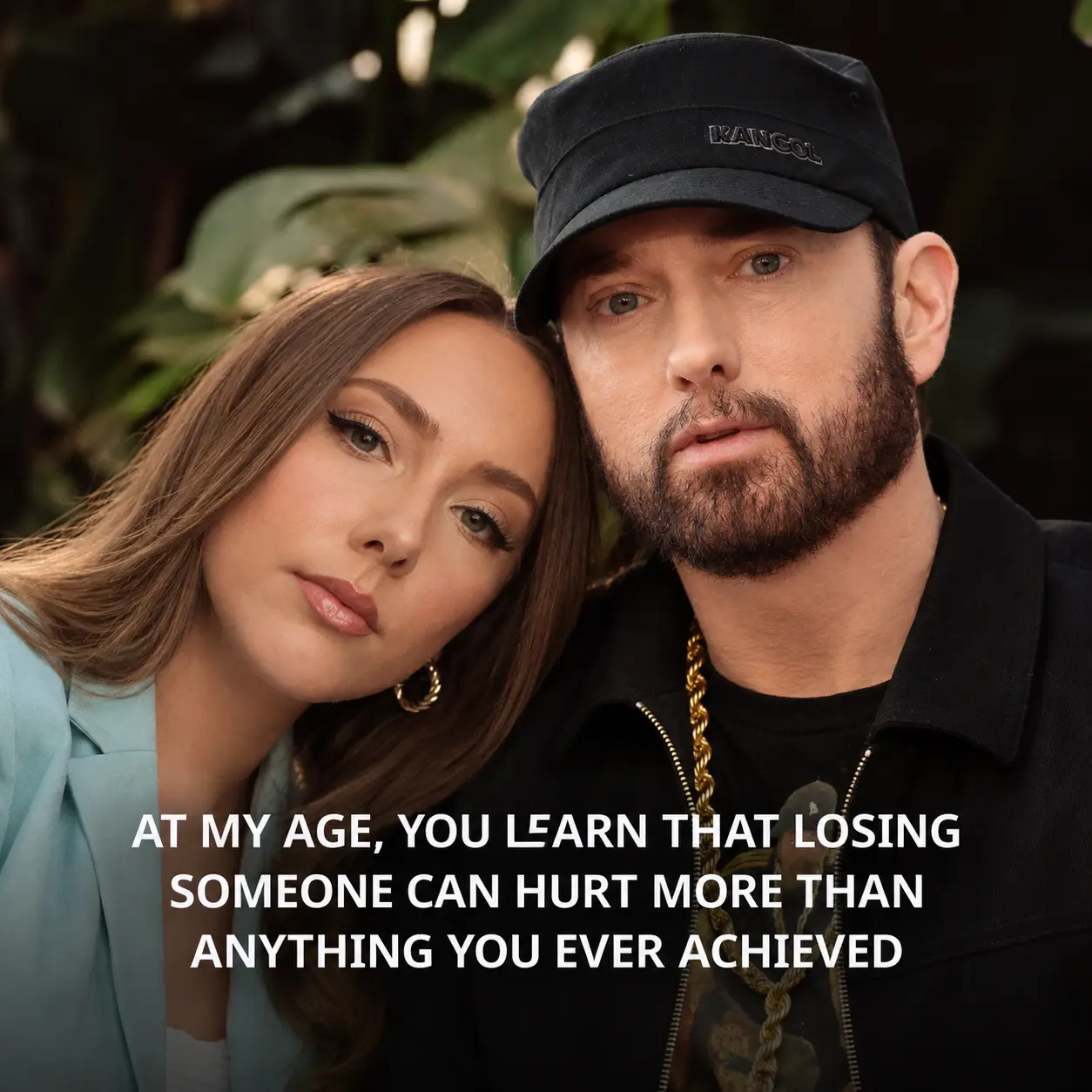
There are moments when success suddenly feels very small.
Awards, money, records, sold-out arenas and worldwide recognition can define a career, but none of them can completely protect a person from the pain of losing someone who mattered.
That is why one deeply emotional sentence currently being associated with Eminem has struck such a powerful chord with fans:
“At my age, you learn that losing someone can hurt more than anything you ever achieved.”
The wording has circulated as though it were a direct personal confession from Marshall Mathers. However, without an authenticated interview, statement or post establishing the quotation's origin, it should not automatically be treated as a verified Eminem quote.
The sentiment behind it, though, feels remarkably connected to a life and career in which loss, loyalty, family and survival have repeatedly appeared beneath the surface.
At 53, Eminem has lived several lives in the public imagination.
There was Marshall Mathers, the struggling young rapper trying to survive around Detroit.
There was Slim Shady, the outrageous character who seemed determined to offend almost everyone.
There was Eminem, the global superstar who became one of the defining rappers of his generation.
And then there was the older Marshall — the father, survivor and veteran artist who had lived long enough to look backward at everything fame gave him and everything it could never replace.
His rise was extraordinary.
When The Slim Shady LP arrived in 1999, Eminem went from fighting for recognition to becoming one of America's most controversial new stars.
Then The Marshall Mathers LP pushed him into another level of fame.
Millions of albums sold.
Awards followed.
Tours grew larger.
His lyrics became national debates.
Everywhere Eminem went, attention followed.

For someone who had experienced financial instability and uncertainty, the transformation was almost unimaginable.
But extraordinary success does not erase ordinary human pain.
Sometimes it magnifies it.
One of the most significant losses in Eminem's life came in 2006, when his longtime friend and fellow Detroit rapper DeShaun “Proof” Holton was killed.
Proof was not simply another musician who happened to know Eminem.
He was a close friend and a crucial figure in the Detroit hip-hop community, as well as a member of D12.
Their history stretched back before much of the fame.
That matters.
When someone knows you before the money, before the awards and before millions of strangers know your name, the relationship carries a different weight.
They remember the version of you that existed before the world started watching.
Proof represented part of that history for Eminem.
His death therefore was not simply an industry loss.
It was personal.
And personal loss has a brutal way of changing perspective.
A trophy can remind you of an achievement.
A platinum record can remind you of a successful album.
A photograph can remind you of a sold-out performance.
But none of those things can recreate a conversation with someone who is gone.
They cannot bring back a laugh.
They cannot answer a phone call.
They cannot create one more ordinary afternoon.
That is the uncomfortable truth hidden inside the quote now being linked to Eminem.
Human beings often spend enormous amounts of their lives chasing achievements.
We want the promotion.
The bigger house.
The successful business.
The recognition.
The number beside our name.
The proof that all the sacrifice meant something.
For Eminem, those achievements reached a scale most people could never imagine.
He became one of the most recognizable artists alive.
His music crossed national borders.

Songs such as “Lose Yourself,” “Stan,” “Without Me,” “Mockingbird” and “Not Afraid” became cultural landmarks.
His influence reached generations of rappers who grew up studying his rhyme patterns and storytelling.
But imagine placing every award in one room.
Then imagine being offered one more conversation with someone you loved and lost.
Which would matter more?
That question becomes harder as people grow older.
Youth encourages us to look forward.
Older age forces us to look backward too.
At 20, the future can feel endless.
At 30, ambition still dominates.
Then birthdays accumulate.
Parents grow older.
Friends change.
Children become adults.
People disappear from our lives.
Suddenly, time becomes more valuable than almost anything money can purchase.
Eminem has experienced that passage of time publicly.
Fans who discovered him as an angry young rapper have watched him enter his fifties.
His daughter Hailie, once the little girl referenced throughout his music, is now an adult with a family of her own.
Marshall himself became a grandfather.
For longtime listeners, that evolution can feel surreal.
The same artist who once represented youthful rebellion is now living through milestones associated with another stage of life.
And with age often comes a different understanding of what matters.
Family has always occupied an unusually important position in Eminem's music.
For all the controversy surrounding his lyrics, some of his most memorable songs have been rooted in vulnerability.
“Mockingbird” remains powerful because it does not depend on celebrity.
At its core, it is about a father looking at his children and confronting the imperfections of the world around them.
That emotion translates across cultures because millions of parents understand it.
You can give your child money.
You can provide opportunities.
You can try to protect them.
But eventually you realize the greatest gift may simply be your presence.
That realization becomes even more meaningful when viewed alongside Eminem's battle with addiction.
Marshall has publicly discussed his struggles with prescription drugs and the overdose that nearly cost him his life.
Recovery forced another confrontation with what achievement actually means.
What value is professional success if you do not survive to experience it?
What good are millions of fans if your children lose their father?
What does another number-one record mean if your health is collapsing?
Those questions fundamentally change the definition of winning.
Recovery gave Eminem something that awards could never provide.
More time.
Time to watch his children grow.
Time to continue making music.
Time to experience family milestones.
Time to look back at friends he had lost and understand how precious survival really was.
That may be why fans respond so strongly to emotional messages connected with him.
They know his story was never merely about music.
It was about endurance.
There were moments when Marshall could have disappeared completely.
Instead, he rebuilt.
But survival also carries its own complicated burden.
The longer you live, the more people you eventually have to say goodbye to.
There is no award for handling that perfectly.
There is no instruction manual.
Grief does not care whether someone is famous.
It does not care about net worth.
It does not care how many people follow you.
When someone important is gone, the absence can feel exactly as devastating inside a mansion as it does inside a small apartment.
Perhaps fame makes that lesson even clearer.
Celebrity surrounds people with enormous numbers of acquaintances.
But genuine relationships remain rare.
Thousands may attend a concert.
Millions may follow an account.
Yet the number of people who truly know the person behind the public image may fit inside one room.
Those are the relationships whose absence can change everything.
Eminem has spent much of his career protecting his private world.
That instinct makes sense.
Marshall Mathers belongs to his family and friends.
Eminem belongs to the public.
The two overlap, but they are not identical.
Fans know the records.
Family knows the silence between them.
Fans remember performances.
Friends remember ordinary days.
Fans know the legend.
The people closest to him know the man.
And perhaps growing older means understanding that the second category ultimately matters more.
Nobody reaches the end of life wishing they had collected one more streaming milestone instead of spending another afternoon with someone they loved.
Achievements matter.
Dreams matter.
Work matters.
But relationships give those achievements somewhere to belong.
Without people to share life with, even enormous success can become strangely empty.
That is why the sentence being associated with Eminem feels larger than celebrity gossip.
It asks everyone reading it to consider their own priorities.
Who matters to you?
Who have you been meaning to call?
Which relationship have you neglected because work always seemed more urgent?
Which ordinary moment are you assuming will always be available?
One day, it may not be.
Eminem's career will eventually be measured through albums, lyrics, sales, awards and influence.
Those things form his artistic legacy.
But Marshall Mathers' life cannot be measured using the same statistics.
That story is written in relationships.
In fatherhood.
In friendship.
In recovery.
In people lost.
And in the people still beside him.
Perhaps that is the deeper truth behind the emotional message.
The older we become, the easier it is to understand that life's greatest victories are not always the ones the world applauds.
Sometimes the greatest victory is simply having another day with someone you love.
Because records can be broken.
Awards can gather dust.
Fame eventually belongs to history.
But when someone you truly love is gone, no achievement can ever take their place.